
Stories I’ve told
Here are a few examples of the sort of thing that I do, they are real documents with just the name of the client amended for privacy.
You’ll also see the option to see what my clients think of the way that I have brought their family history to life.
I recently completed a family history for a gentleman who lives quite close to me and he asked if I would get in touch with his neighbour. The neighbour wanted to know if I would meet with his mother to discuss the possibility of locating her cousin who she hadn’t seen for the better part of 80 years!
We met up and she gave such detail as she had – when her father died in 1986 she discovered a letter from her cousin from 1963 with an address a few miles from her in Essex. She dashed straight round but, not entirely surprisingly, 23 years later nobody could remember her cousin. She knew the name of her cousin’s husband, the names of her parents and that she was about to give birth in 1963 but not much else
More in hope than expectation I agreed to take a look. I was able to find the cousins marriage, thankfully she had married a man with a relatively unusual name, and the birth of their son in 1963. I also found what looked like them on the transcription of the electoral register in Dorset from 10 years earlier. I found what I thought was the cousin’s Facebook page and tried messaging but, given that she was in her 80s, I don’t think she did much on Facebook. One of her friends on Facebook was a local church so emailing the administrator there confirmed that I had found the long lost cousin and a long overdue reunion followed
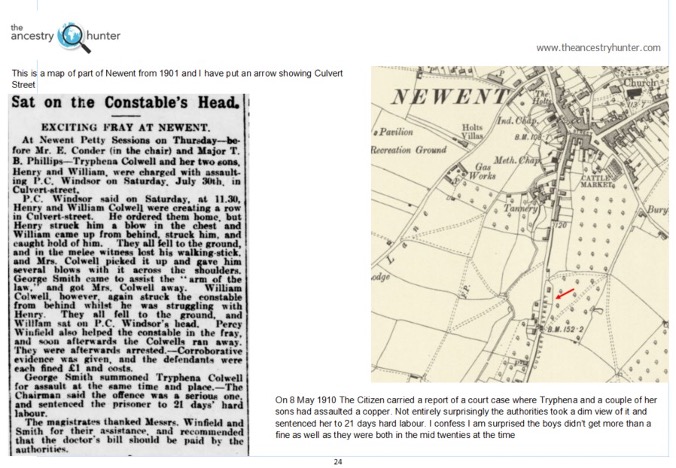
My client’s great great granny was called Tryphena and her husband had an ongoing relationship with the police force. In 1910, when she was 52 years old she had something of an altercation with the law herself, ably assisted by a couple of their sons
My client commented after reading it that if she’s known about Tryphena when she had her children her daughter would have been named after her!
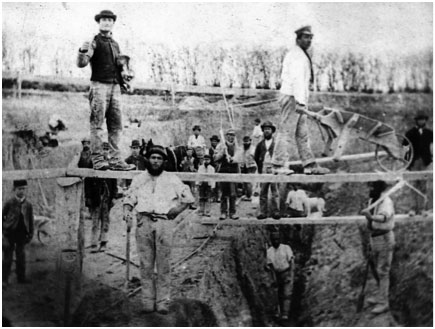 One of my client’s ancestors was working as a Coprolite Digger in 1871.
Coprolite is fossilised dinosaur poo that grinds down to make a reasonable fertiliser. The industry only lasted for around 15 years in East Anglia before stocks started to run out.
As you can see it’s not a complicated mining system – just a group of guys digging up fields.
What I have always wondered is who came up with the idea of digging up a rock that looks like giant horse poo, grinding it down and putting it on the crops?
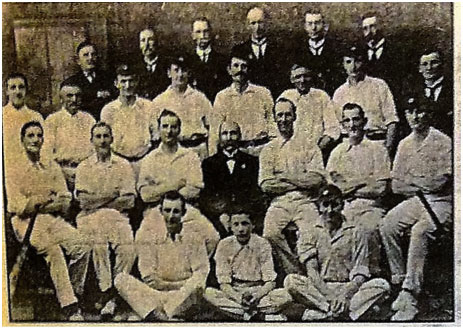 In the 1860’s and 70’s some of my clients’ ancestors emigrated from Scotland to Australia.
They clearly liked it there and thrived having typically Victorian numbers of kids.
So much so that by the time they were celebrating their 50th anniversary as a family over there they had their own cricket club made up entirely of family members in Melbourne!
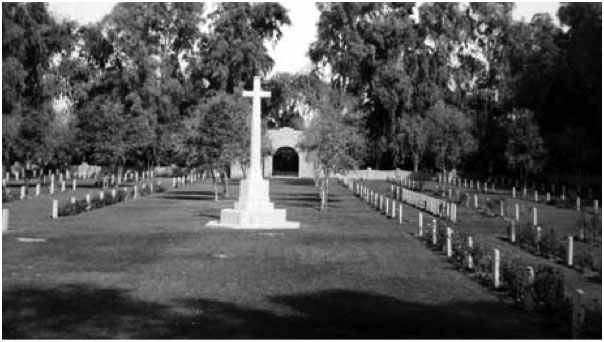 In May 1941 my client’s uncle died during the Battle of Habbaniya in Iraq – I hadn’t heard of it either!
35 qualified pilots at an RAF training base using mostly WW1 aircraft and supported by trainees to swell the numbers and ground staff to act as observers and gunners, held up a German backed Iraqi force of some 9000 men and artillery long enough for a British ground force to arrive to defeat them.
Their sacrifice probably saved the middle eastern oilfields from falling into enemy hands and made a massive contribution to victory in WW2.
This is the start of the introduction to a family history of a gentleman based in Florida, USA.
The Paternal line
THE STEMPLE FAMILY
This line starts at XXXX and goes straight back through his father and down the Stemple line.
I now believe that I can trace them back to 16th century Switzerland although by the time that they emigrated to America they were living in what is now the German Rhineland.
I have accessed detail from several family trees to build up a full picture of the family.
The Stemple family seem to have been based in Pennsylvania for all their time in America, living steadily in the Chester or Montgomery County areas, the furthest afield so far goes back into the 1700s and Horsham, PA given as a place of birth. Hardly a million miles away.
I have found exerts from a book written in the 1920’s that has been very informative – “Montgomery County, A History” – here is a quote that seems to sum up the Stemple presence in the area:
One of the well known names in Montgomery county, Pennsylvania, is that of Stemple, it’s early members coming from Chester county and settling in Conshohocken early in the nineteenth century.
Stemple
The name with many origins although I now believe that it started out in Switzerland as STAEMPFLI, which seems to have Jewish origins – although I haven’t been able to truly pin it down there is no doubting that many of the early Staempfli ancestors had first names attributed to Jewish families.
Whether this means that they were of Jewish origin would be pure conjecture and they certainly practiced Lutheran Christianity when they arrived in America.
Whatever the origins of the name there is still a printing company with the name of STAEMPFLI in Bern, Switzerland today!
When they moved into Germany in the mid 1600’s the name seems to have changed to STEMPEL, probably to make it more Germanic and to avoid the apparently endless religious persecution that was the norm in that area at that time.
When the spelling was re-arranged I cannot be sure as I am working from type written transcripts from the 1700’s rather than the original documents but, as is seen in other families of Germanic origin, a certain “Americanisation” of the surname seems to take place around the time of the emergence of America as an independent country.
The name Stempel originates from German and Jewish (Ashkenazic): from Middle High German Stempel ‘(coin) stamp’, hence a metonymic occupational name for a worker in a mint or someone who made seals but whether that was their trade back then or whether it was a name that sounded like their original one I have no way of knowing.
I knew I had the right family when my client remembered his great uncle and aunt – and their car.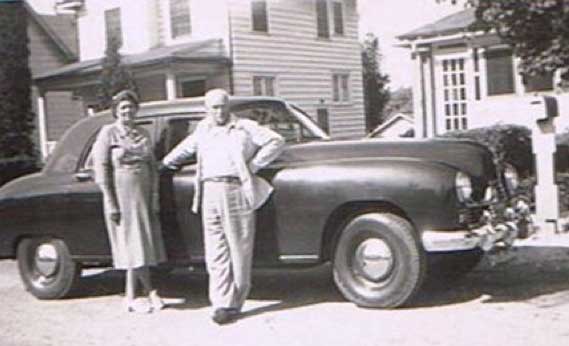
He would have been around 6 or 7 when this photograph was taken.
The words below were written by a cousin that my client had lost touch with, this brought them back into contact.
One of the things I’ve heard my brother, Richard, say often is that when anyone in Upper Merion found out that he was Harry McIntyre’s grandson, they would have a story to tell about what a wonderful man PopPop was. Richard said that he never met anyone who had anything by high praise for both of our grandparents.
This wonderful man, whose favorite song was “Mule Train” who loved to grow vegetables in his garden, took wonderful care of his precious “Henry J” automobile, who loved and took care of his family so well and was always ready with a quick smile and a hug… will live in my heart forever.
The picture is of Harry and Elsie and I would guess from the car sometime around 1950.
My client’s great grandfather was born in Ireland and this is how he travelled to the United States.
His bride to be had already left County Mayo and was living in the US.
Thomas Francis SKELLY
1860 – 1927
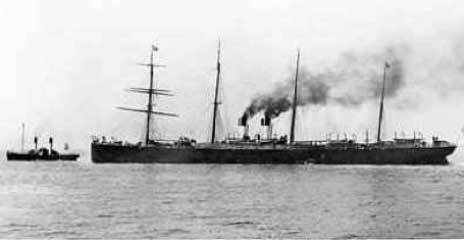 XXXX’s great grandfather was baptised in Drogheda, County Louth, Ireland on 21 April 1860.
He died in Norristown, PA in 1927.
With transatlantic transport no longer using his birth town Thomas had to make the trip to the south coast. I believe he arrived on board the “Spain”, landing in New York on 3 May 1880 and describing himself as a Labourer.
The “Spain” was operational from 1871 to 1896 by National Lines, carried around 1200 passengers and took between 7 and 10 days to make the crossing; starting at Liverpool and collecting Irish passengers from Queenstown (Cobh) in County Cork, Ireland.
Client’s great grandmother was born in Cornwall, UK and like so many people left that area when the jobs dried up in the mid 1800’s.
Her husband was a gold prospector for 20 years or so and managed to support himself and his family over that period.
THE VERCOE FAMILY
Obituary for Zoom’s great great grandmother Mary Ann VARCOE b.1830, d.1918
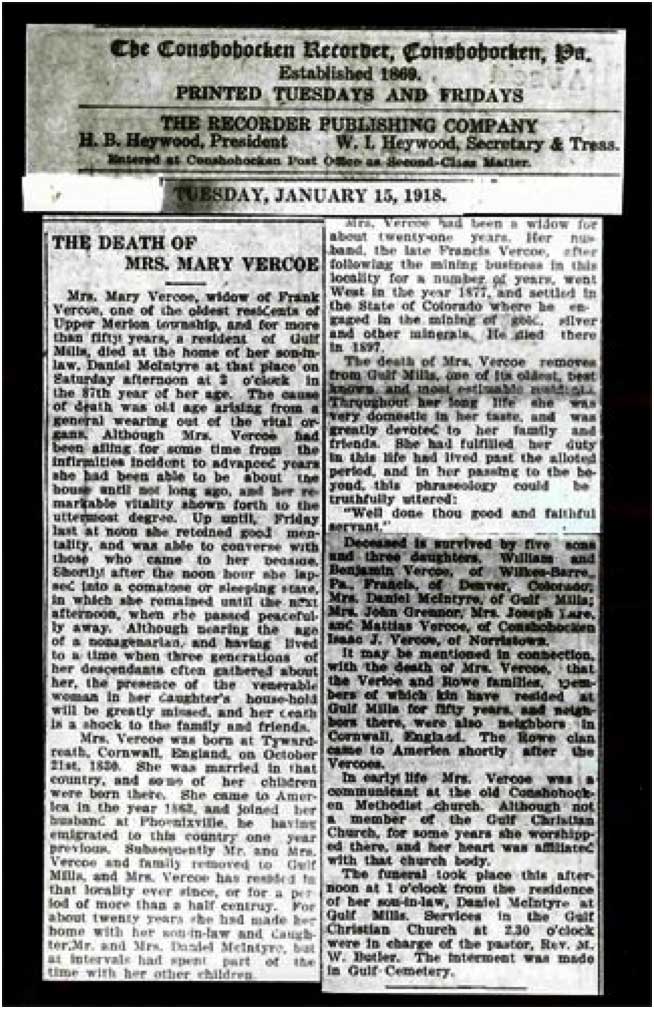
All my client knew about her mother was her maiden name, when she was born and the names of a couple of her sisters.
This is the uncle she never knew she had, he became a US citizen and these photos were the first time she had ever seen her uncle.
William Richard MILLER. 1868 –
 The oldest of the family was born on 25 November 1868 in the registration district of Kensington, London, probably Bayswater as that was where his parents married. He lived with the family up to the 1891 census.
In 1891 he was working as a Gas Fitter; the entries for both him and his father, John, have the word “Lock” written after them but whether that means they were working together – possibly at a lock – or something else entirely isn’t clear yet.
The entry on father John’s death certificate suggests that he had worked at the Gas Works where it was stored; perhaps his son was with him there.
He became the first globe-trotting Miller that I found.
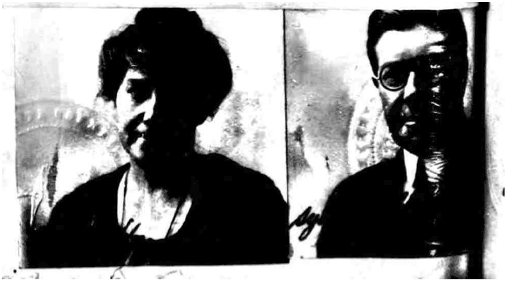
William and Dorothy Miller photographed
in 1923 for their American passport renewal.
He doesn’t appear on the 1901 census but reappears on the 1911 having been in America, got married and had a daughter.
The most likely entry for his original departure from the UK would seem to be on the Campania which sailed from Liverpool to New York on 14 October 1893. The entry for William Miller reads Engineer.
MARRIAGE He married a lady called Dorothy around 1894, she was born in Boston Mass. on 5 November 1869 (according to her passport application – see below).
The mother of the Lucy in the text died in a workhouse hospital in 1915.
Whatever caused the break between her and her daughter it was very serious – daughter living the life of a millionaire and mother a pauper? That is some falling out.
As it is clear that Lucy and Sydney were living together as a couple at least 18 months before they married I have to float the idea that any break in the family might have been instigated by a disgusted and socially embarrassed Victorian matriarch, Lydia.
 Did Lydia MILLER disown her daughter for living in sin?
Did Cicely Smith react in a similar fashion?
I have no idea which if any of the above applied but what does seem to be the case is that four of the sisters became distanced from their mother and other siblings and it seems to hinge around the social progression of Lucy and possibly Florrie.
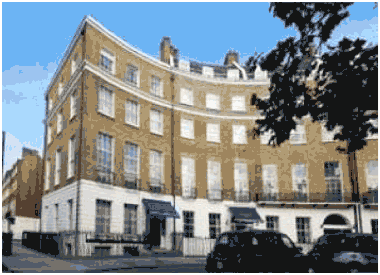
On the 1911 census, thanks to Susan’s tip about their address, I found them living at 62, Great Cumberland Place, London. The house had 17 rooms and they have 5 servants and they were living alongside Lords and Ladies and he is shown as a Director of Public Companies so he was clearly successful.
Modern day Great Cumberland Place.
A 2 bedroom flat in the property pictured is on the market for £1,100,000.
The 1921 census in the UK has yet to be released so tracking beyond 1911 can be interesting.
I tracked these people by their unusual name which, as they were wealthy and could afford a telephone a hundred years ago, gave me a useful tracking device.
The riddle of the Smith Winby’s continues – how did a Solicitor become a Journalist and then a Company Director – what an unusual career path he had.
I was able to find entries in the London telephone directory for various years and this is what they show:
1907 to 1910 JS Smith-Winby 12 Evelyn Gardens, Kensington 640
1911 to 1913 JS Smith-Winby 62 Great Cumberland Place; Paddington 1687
1914 to 1917 JS Smith-Winby 40 North Audley Street; Mayfair 4076
So, when her mother died in a Workhouse Hospital Lucy was living in Mayfair.
I can’t find entries online for 1918 and 1919 so it isn’t clear when they moved out of London. Throughout the entire period there is only one entry for Smith-Winby which suggests that this is them.
1920 to 1921 JS Smith-Winby Walton Heath Cottage, Walton on the hill, Surrey; Burgh Heath 236
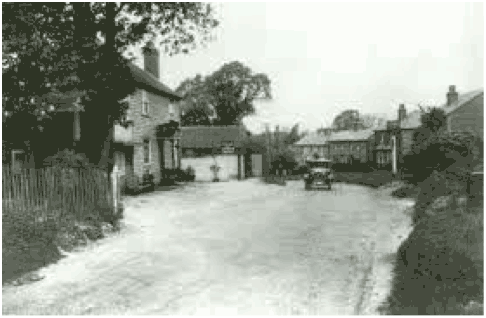 Walton on the Hill in the late 1920’s.
This was the sleepy village that they seemed to retire to.
Walton Heath Cottage is a 6 bedroom detached house with large conservatory and a very large garden backing on to open land.
Amongst their neighbours was a bloke called David Lloyd-George!
1922 Mrs Smith-Winby 2 Portland Court W1; Langham 1268
1923 to 1924 Mrs Lucy Smith-Winby 37 Cumberland Mews W1; Paddington 2643
My client’s very distant cousin had a talent for “borrowing” from his investors and then travelling to the other side of the world!
The GREEN FAMILY – the children of James GREEN and Sarah CARD
John Card GREEN (contd)
CHILDREN (contd)
Mary Lampard FORWARD (nee GREEN) (contd)
I love the line in the 1870’s Smedley’s brochure which talks of “equable” winter temperatures of 45 degrees. I was born in Derbyshire and that’s a bare faced lie. Nice to see the tourist industry hasn’t changed in 150 years.
They next surface on the other side of the world! They emigrated to Launceston, Tasmania.
Launceston, clearly named after the Cornish town, is located on the Tamar, North Esk and South Esk rivers.
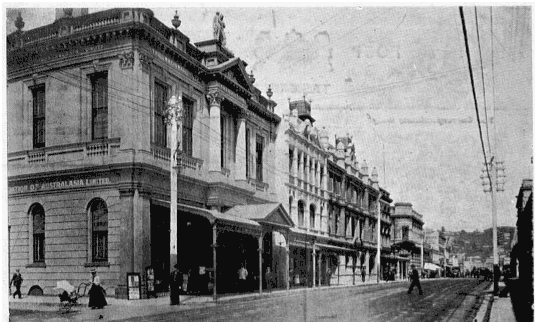
The main street in Launceston, Tasmania around 1900.
The population in 1891 was 17,208 and by 1911 had risen to 20,754. This relatively small city opened it’s own Albert Hall in 1891. It is the second largest city in Tasmania.
What happened to the Hydro empire? Why did they leave so suddenly? It seems a big step from business mogul to pioneer in 12 months.
I have found evidence that Giles’s aunt, Sarah Forward, emigrated to Australia in 1850 and some of his cousins had also gone out there, perhaps that was a link?
They sailed to Melbourne on the Sir Walter Raleigh and arrived there on 17 August 1882, not sure exactly when they moved to Tasmania.
Mary died in 1884 in Tasmania.